
Building Organizational Agility in GCC
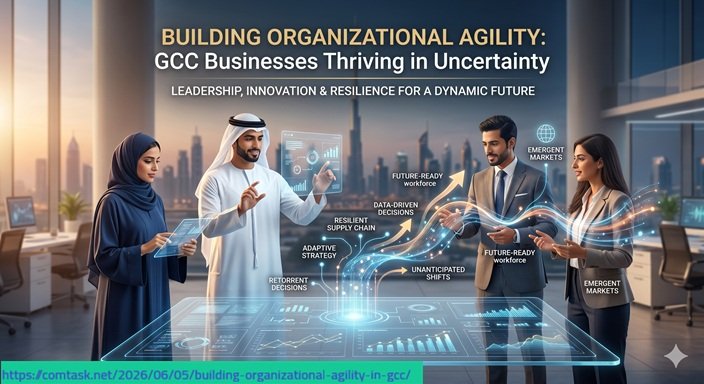
Organizational Agility: 4 Powerful Ways GCC Businesses Can Adapt Faster
Organizational agility is now one of the most important capabilities for businesses in the UAE and wider GCC. The pace of change is increasing through national transformation plans, hybrid work, AI disruption, new customer expectations, and shifting global trade patterns.
The organizations that will lead the next decade are not always the ones with the most resources. They are the ones that can sense change early, decide quickly, and act effectively.
That is what organizational agility means. It is not a personality trait. It is a business capability. It can be built deliberately through structure, governance, communication, and learning.
Table of Contents
- What Organizational Agility Actually Means
- The GCC-Specific Agility Challenge
- 4 Powerful Levers of Organizational Agility
- Getting Started with Organizational Agility
- How COMTASK Can Support Your Organization
What Organizational Agility Actually Means
Agility is often misunderstood as speed alone. True organizational agility combines three capabilities:
- The ability to sense change early.
- The authority to decide quickly.
- The capacity to act effectively.
An organization that spots a market shift but takes six months to respond is not agile. An organization that moves fast but in the wrong direction is not agile either.
In practice, organizational agility appears in specific and observable ways. Agile organizations have fewer approval layers. They have clear ownership. Teams know who is accountable for what. They do not wait for permission when the decision is already within their scope.
Agile organizations also communicate in ways that do not require everyone to be in the same room at the same time. They use shared documents, dashboards, project boards, and decision logs. They also treat every completed project as a source of learning, not only as a success or failure.
The GCC-Specific Agility Challenge
Organizations in the UAE and wider Gulf face a specific set of agility challenges. Many businesses operate with hierarchical leadership structures. Important decisions often require senior approval. This model may work in stable environments, but it becomes a bottleneck when markets move quickly.
Many GCC organizations also work with multicultural teams across different nationalities, time zones, and working styles. This creates coordination complexity. Without clear systems, that complexity slows response time and weakens execution.
At the same time, the GCC has a major advantage. Government transformation programs are reshaping the business environment. The UAE’s We the UAE 2031 vision focuses on social, economic, investment, and development priorities. Saudi Arabia’s Vision 2030 focuses on building a more diversified and high-performing economy.
Companies that align internal agility with this external transformation agenda can move faster, respond better, and compete more effectively.
4 Powerful Levers of Organizational Agility
1. Flatten Decision-Making Authority
The single most important structural change many GCC organizations can make is to move decision rights closer to the work.
This does not mean removing leadership oversight. It means defining which decisions require leadership approval and which decisions teams can make directly.
A simple decision rights framework can reduce internal delays. It helps teams know when to act, when to consult, and when to escalate.
For example, leadership may approve major budget shifts, regulatory risks, and strategic partnerships. Teams may handle routine vendor selection, campaign adjustments, task prioritization, and operational problem-solving within agreed limits.
2. Invest in Asynchronous Communication Infrastructure
Meetings are useful when discussion is needed. But many meetings are expensive, slow, and unnecessary.
Agile organizations use asynchronous communication. This means teams can stay aligned without needing everyone to join the same meeting at the same time.
Useful tools include:
- Shared project trackers.
- Decision logs.
- Standard operating procedures.
- Internal knowledge bases.
- Dashboards and status updates.
This matters for GCC businesses because many teams are distributed, multicultural, and cross-functional. Clear written communication reduces confusion and improves speed.
3. Build Small Cross-Functional Teams
When a new challenge or opportunity appears, agile organizations do not push it through slow departmental structures. They create a small, focused team with the right skills.
A cross-functional team may include people from strategy, operations, finance, technology, marketing, customer service, and legal. The team should have a clear mandate, a deadline, and the authority to make decisions within its scope.
This approach works because it reduces handovers. It also improves ownership. Instead of waiting for different departments to respond one by one, the right people solve the problem together.
4. Create Explicit Learning Loops
Organizational agility becomes weaker when organizations do not learn from experience.
Agile organizations build short and honest learning loops into every project. After each initiative, the team should answer simple questions:
- What worked?
- What did not work?
- What slowed us down?
- What should we repeat?
- What should we change next time?
These reviews should be practical, brief, and focused on improvement. The goal is not to blame people. The goal is to improve the system.
Organizations that institutionalize learning improve their response capability over time. This creates a real agility advantage.
Getting Started with Organizational Agility
Organizational agility is not a one-time transformation project. It is an ongoing commitment to removing friction between sensing change and acting on it.
The best starting point is an honest agility assessment. Leadership teams should identify where friction currently exists.
Common friction points include:
- Too many approval layers.
- Unclear decision rights.
- Weak ownership.
- Too many meetings.
- Poor project visibility.
- Slow communication.
- Resistance to decentralized decision-making.
This assessment should include input from people at different levels of the organization. Senior leaders may see the strategy. Frontline teams often see the friction.
How COMTASK Can Support Your Organization
COMTASK’s Management Consultancy practice helps GCC organizations design and implement agile operating models that are practical, culturally appropriate, and built for sustained performance.
We support organizations through strategy design, organizational structure review, decision rights mapping, project governance, change management, and implementation support.
Related COMTASK services include:
- Management Consultancy
- Project Management
- Digital Transformation Consultancy
- IT Solutions and Consulting
- Contact COMTASK
If your organization needs to move faster, reduce internal friction, and improve execution, contact COMTASK at [email protected] or visit our contact page.