
Supply Chain Resilience: 5 Practical Steps for UAE Businesses
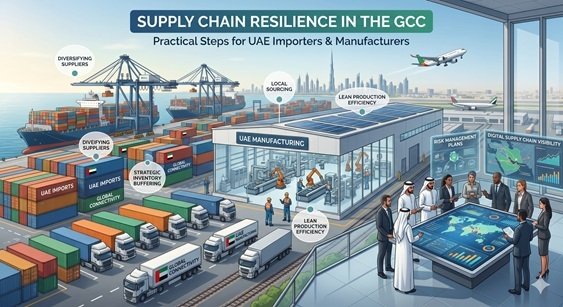
Supply chain resilience is now a core business requirement for UAE importers, manufacturers, and trading companies. The UAE’s position as a global trading hub creates major opportunities, but it also exposes businesses to global supply chain risks.
Many UAE businesses depend on international suppliers for food products, manufactured goods, raw materials, spare parts, packaging, technology components, and industrial inputs. When global supply chains face disruption, local businesses can face delays, higher costs, lost sales, and pressure on customer commitments.
Supply chain resilience is not only for large corporations. It is a practical necessity for any UAE business that buys from international suppliers or depends on imported goods.
Table of Contents
- The Supply Chain Risk Profile Has Changed
- 5 Practical Steps to Build Supply Chain Resilience
- The Cost-Benefit Reality
- What UAE Businesses Should Do Next
- How COMTASK Can Support Your Supply Chain
The Supply Chain Risk Profile Has Changed
Five years ago, supply chain risk in the UAE was often viewed as a shipping issue. Businesses mainly worried about port congestion, freight delays, and supplier lead times.
Today, the risk profile is broader and more complex. Geopolitical tensions can affect shipping routes. Regional disruptions can increase freight costs and delivery times. Climate-related events can affect agricultural supply. Semiconductor shortages can affect manufactured goods. Currency fluctuations can reduce margins on foreign-sourced products.
These risks affect importers, manufacturers, distributors, retailers, e-commerce companies, and procurement teams. Managing them requires a more structured approach than relying on one supplier, one freight route, or one logistics provider.
UAE businesses can also benefit from reviewing official trade and customs guidance through the UAE Government customs information portal and the World Trade Organization.
5 Practical Steps to Build Supply Chain Resilience
1. Map Your Single Points of Failure
The first step in supply chain resilience is to identify where your business is most exposed.
Start by listing every critical input where you depend on one source. This may include:
- A single supplier for a key product or component.
- A single country of origin for an important input.
- A single freight route for a product category.
- A single warehouse serving a major market.
- A single logistics provider handling most shipments.
These single points of failure are where a disruption can become a crisis.
After mapping them, rank each risk by business impact. Not all single points of failure carry the same level of danger. A delayed office supply is not the same as a delayed production component or a food product with limited shelf life.
2. Qualify Alternative Suppliers Before You Need Them
The worst time to search for an alternative supplier is during a disruption.
When your primary supplier fails, your negotiating position becomes weak. Quality checks become rushed. Prices may increase. Lead times may extend when you need faster delivery.
UAE importers and manufacturers should qualify backup suppliers before disruption happens. This does not mean placing large orders immediately. It means confirming that an alternative supplier can meet your standards.
Basic supplier qualification should include:
- Company verification.
- Product quality review.
- Sample testing where needed.
- Price comparison.
- Production capacity check.
- Delivery lead time review.
- Compliance and documentation review.
Qualifying one backup supplier can reduce risk significantly. It is one of the highest-value risk management actions for trading and manufacturing businesses.
3. Increase Visibility into Your Tier-2 Supply Chain
Many UAE businesses know their direct suppliers well. Fewer businesses know where those suppliers source their own materials.
This creates hidden risk. A disruption may begin at tier-2 or tier-3 supplier level before your direct supplier informs you.
Start with one simple question for your key suppliers:
Where do you source your critical inputs, and what contingency plans do you have if those inputs are disrupted?
This question creates better visibility. It also shows whether your supplier manages risk seriously.
For high-risk products, you may also request information about country of origin, production capacity, alternative sourcing options, and inventory availability.
4. Recalibrate Safety Stock for the New Risk Environment
Many businesses still use safety stock assumptions from a more stable supply chain environment.
Those assumptions may now underestimate risk. Lead times are less predictable. Freight costs change quickly. Some products face sudden shortages. Supplier reliability can vary by country, route, and sector.
For critical inputs, review your safety stock using current lead time variability, not only historical averages.
For example, if a key component previously had a six-week lead time but now often takes 10 to 12 weeks, your safety stock policy should reflect that change.
Holding extra stock is not always inefficiency. For high-criticality products, it may be appropriate risk management.
5. Diversify Logistics Providers
UAE businesses that depend on one freight forwarder or logistics provider may be more exposed than they realize.
Rates, capacity, routing options, customs handling, and delivery reliability can vary by provider. Working with more than one logistics partner gives your business flexibility and negotiating power.
This is especially important for businesses that depend on sea freight, regional distribution, cross-border trade, or time-sensitive imports.
A resilient logistics setup may include:
- More than one freight forwarder.
- Alternative shipping routes.
- Air freight options for urgent goods.
- Backup warehousing options.
- Clear customs documentation processes.
- Regular freight cost monitoring.
The Cost-Benefit Reality
Supply chain resilience investments can look like extra cost during normal times. Backup suppliers, extra safety stock, supplier audits, and additional logistics options may appear unnecessary when everything is working.
But their value becomes clear during disruption.
The best way to assess the business case is to calculate a disruption scenario. For example:
- What would happen if your main supplier stopped delivery for 90 days?
- What revenue would you lose?
- What penalties or customer losses could occur?
- How much would emergency sourcing cost?
- How much margin would be lost through higher freight or urgent procurement?
Then compare that disruption cost with the annual cost of resilience measures. In many cases, the cost of resilience is lower than the cost of one serious disruption.
What UAE Businesses Should Do Next
UAE importers and manufacturers should treat supply chain resilience as a management discipline, not as a reaction to crisis.
The starting point is simple:
- Identify your critical products and inputs.
- Map single points of failure.
- Review supplier reliability.
- Qualify backup suppliers.
- Update safety stock assumptions.
- Diversify logistics providers.
- Track supply chain risks monthly.
These actions do not require a large transformation program. They require discipline, ownership, and better visibility.
How COMTASK Can Support Your Supply Chain
COMTASK’s General Trading practice helps UAE businesses assess supply chain risk, qualify alternative suppliers globally, and build practical resilience plans.
We support organizations through supplier sourcing, procurement support, trading coordination, supply risk assessment, logistics planning, and business continuity support.
Related COMTASK services include:
If your business depends on imported goods or international suppliers, contact COMTASK at [email protected] or visit our contact page to discuss your supply chain resilience needs.